Cookies & PrivacyThis site uses cookies to ensure you get the best browsing experience. By using our site you agree to our Cookie Policy and updated Privacy Policy
Dream Journaling: How To Keep a Dream Journal and What To Do With It
How to choose a dream journal, what to write the moment you wake up, prompts to get you started, and how to find the patterns in your dreams over time. Includes a printable template and a filled-in example.
A dream journal is a notebook, app or voice memo where you record your dreams as soon as you wake up. To keep one, put it right beside your bed. Write before you get up or check your phone. Note how the dream made you feel as well as what happened, and read back through your entries every week or so. Over time, dream journaling can help you remember more dreams and notice the people, places and feelings that keep coming back. If you’d like a page to start with, here’s our printable dream journal template.
What Is a Dream Journal?
A dream journal is simply a record of your dreams. A notebook is the most common choice, but it doesn’t have to be pen and paper. You can sketch scenes and symbols, type notes on your phone, or record yourself talking through what you remember. The best format is the one you’ll actually keep using, and that lets you easily look back at old entries.
Your dreams are personal. They can reflect what’s on your mind, what you’re feeling, and sometimes what your intuition is trying to tell you. A dream journal helps you capture them before you forget.
Benefits of Keeping a Dream Journal
Writing down your dreams may help you:
Remember more of them. Keeping a dream journal appears to improve dream recall, and many dreamers find that the more attention they give their dreams, the more they remember.
Notice patterns. Recurring places, people and symbols are easier to spot when they’re on paper.
Understand your feelings. Research suggests your mood during the day is closely linked to your dreams. In one study, people who felt frustrated during the day reported more negative feelings in their dreams.
Ease stress. Writing down a stressful dream can help you let it go.
Slow down. A few quiet minutes with your journal each morning is a small mindfulness practice.
Bring something to therapy or a reading. Recurring themes give you something concrete to explore with a therapist or a psychic.
If you’d like to try lucid dreaming, a journal may help there too. Some lucid dreamers say keeping one helps them notice their personal “dream signs.” Here’s more on the power of lucid dreams.
Dream journaling is one kind of journaling, and the habit itself has benefits. The University of Rochester Medical Center says journaling can help you manage anxiety, reduce stress and cope with depression. It works best alongside other healthy habits and isn’t a replacement for care. If anxiety or a low mood is weighing on you, talk to your doctor or a mental health professional.
Choosing Your Dream Journal
You don’t need anything special. Here’s how the three main options compare:
Format
Good for
Watch out for
Paper notebook
Drawing what you saw, flipping back through old dreams, no screen first thing
Writing in the dark. A small clip-on book light helps without waking anyone
Phone app or notes
Searching old entries, tagging symbols, always with you
Notifications pulling you out of the dream before you write it down
Voice memo
Capturing a lot of detail quickly when you’re half asleep
Speaking can wake you up fully, and voice-to-text can confuse what you said
Whichever you choose, keep it in the same spot by your bed every night. If you’re using paper, keep a notebook just for your dreams, with a pen beside it.
How To Start a Dream Journal
Before you fall asleep
Set an intention. Write “I’ll remember my dreams tonight” in your journal and say it a few times. Some dreamers find that after a few nights, at least fragments start coming through.
Ask a question. If something is on your mind, write it down before bed and ask your dreams for guidance. You might ask for help with a decision, a creative block, or your next step.
Get your space ready. You might like a calming bedtime ritual, or a crystal on the nightstand. Here are the best crystals for dreams.
If you rarely remember your dreams
Try to get a full night’s sleep. Most REM sleep, the stage linked with vivid dreaming, happens in the second half of the night, so a full night gives you the most time to dream.
Some people who practice lucid dreaming set an alarm for at least five hours after bedtime, write down what they remember, then go back to sleep. Waking in the night does cut into your sleep, though. If you’d like to try it, check with your doctor first, especially if you already have trouble sleeping.
If a dream wakes you up in the night, jot down a few words before you fall back asleep. Later dreams can push the earlier one out of your memory.
What To Write When You Wake Up
Write before you do anything else. Dreams fade fast once you get up, check your phone, or start thinking about the day. Even a fragment is worth writing down. Small pieces can sometimes lead you back to more of the dream.
If you only have 30 seconds
Some mornings all that’s left is a scrap. That’s enough to work with. Before you move, write three things:
One image. “Red door.” “Mom’s kitchen.”
One feeling. “Uneasy.” “Relieved.”
One word about yesterday. “Deadline.” “Argument.”
Three scraps still count as an entry, and they’re enough to show a pattern when you read back later. On mornings with more time, use the fuller layout.
Psychic Jesse ext. 9027 hears this from clients often:
Many clients will tell me they can’t recall their dreams, but if you record whatever you can recall: a color, a feeling, a person, even if you can’t make sense of it, your mind has registered something important.
Psychic Jesse
A fuller entry
Here’s a simple layout for each entry:
Date and, if you like, a short title for the dream
What happened, in as much detail as you can. Some dreamers like to write in the present tense (“I’m walking down a hallway”)
Who and what was there: people, animals, places, colors, sounds, objects
How you felt, during the dream and when you woke up. Feelings can carry a lot of the dream’s meaning
A quick sketch of anything that’s easier to draw than describe. You don’t need to be an artist
What’s going on in your waking life right now that the dream might connect to
Your first impression of what it means. Write it down as a guess, even if it seems odd. You can change it later
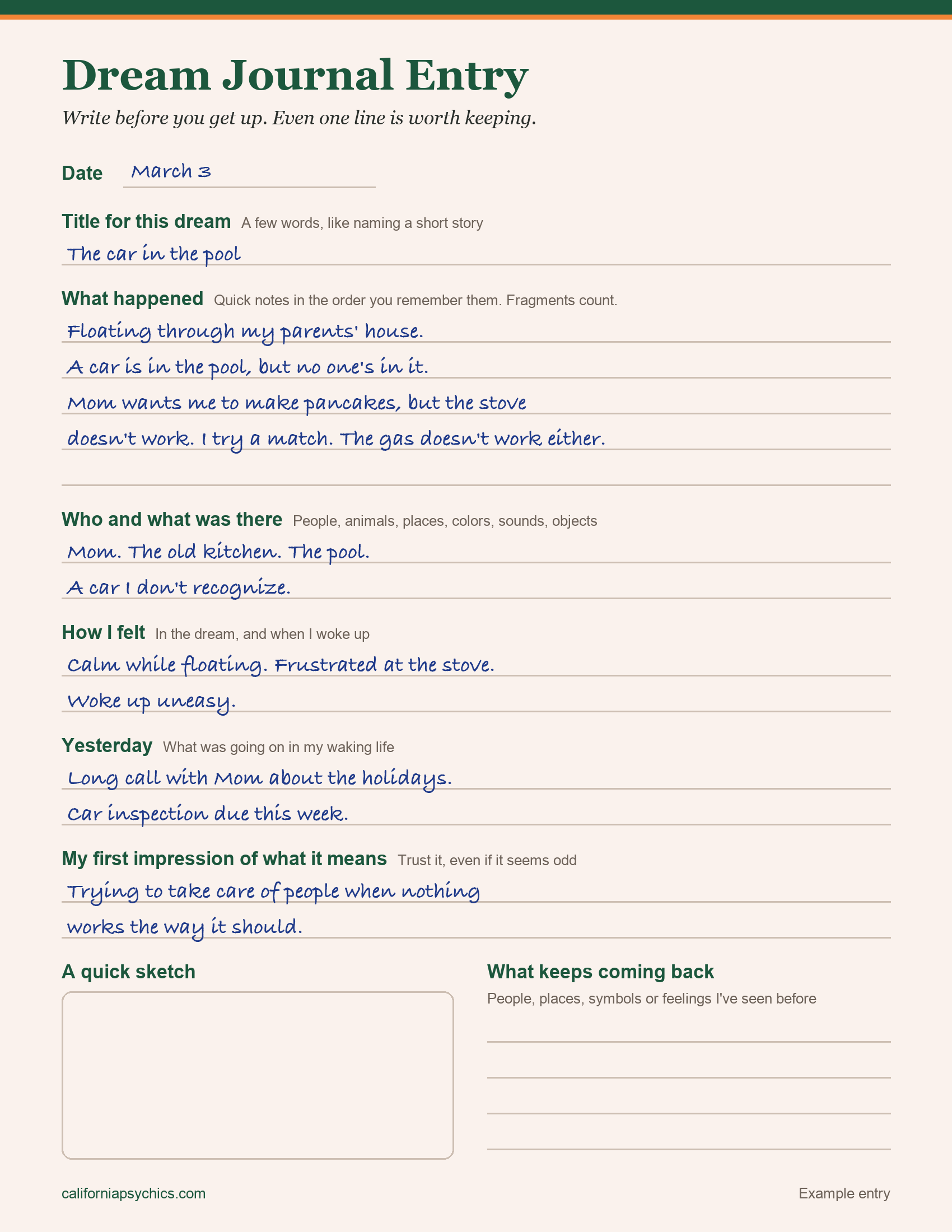
A printable dream journal template, with a sample entry
You don’t need full sentences. Quick notes, in the order you remember them, are enough. Here’s an example we put together to show the layout:
Part
Example
Date and title
March 3. “The car in the pool”
What happened
Floating through my parents’ house. A car is in the pool, but no one’s in it. Mom wants me to make pancakes, but the stove doesn’t work. I try lighting it with a match, and the gas doesn’t work either.
Who and what
Mom. The old kitchen. The pool. A car I don’t recognize.
How I felt
Calm while floating. Frustrated at the stove. Woke up uneasy.
Yesterday
Long call with Mom about the holidays. Car inspection due this week.
First impression
Trying to take care of people when nothing works the way it should.
The “yesterday” line matters more than it looks. After a few weeks you may see which kinds of days lead to which kinds of dreams.
Once you have a few weeks of entries, reading them back is when the patterns start to emerge.
Review once a week. Read the week’s entries in one sitting. Patterns jump out much more clearly than they do one morning at a time.
Mark what repeats. Underline or tag recurring people, places, symbols and feelings. A simple index at the back of the notebook makes them easy to find later.
Compare with your days. Notice whether certain dreams show up around certain events, moods or relationships.
Look up symbols, then trust yourself. Dream dictionaries and guides can give you a starting point, but symbols are personal. If a cat scratched you as a toddler, a cat in your dream may mean danger. For someone else it means comfort. Your journal slowly becomes your own dictionary. If you’re curious about specific symbols, see what it means to dream about death or a haunted house, or browse these common questions about dreams.
Share it. Telling a partner or friend about a dream can bring up a meaning you missed. So can a reading with a dream analysis psychic. If it’s your first one, here’s what to expect from a psychic reading.
What a few weeks can show
Here’s an example we put together, carrying on from the sample entry above. This shows four short entries from one month:
Date
The dream, in a line
How I felt
Yesterday
March 3
A car in the pool. The stove won’t light
Frustrated, uneasy
Long call with Mom about the holidays
March 11
Late for a train, and my ticket is blank
Rushed
Car inspection. A packed week at work
March 19
Cooking for a crowd, and the oven is cold
Frustrated
Agreed to host the holidays
March 24
Driving, and the brakes feel soft
Uneasy
Mom called again about the plans
Read one at a time, none of these say much. Side by side, three of the four have something that won’t work when it’s needed, and three follow a day about family plans. That’s a pattern worth a question: am I taking on more than I can carry for the holidays?
Notice how the reading changed, too. On March 3 the first impression was “trying to take care of people when nothing works the way it should.” Three weeks later it’s narrower, and it points at one situation. A first impression is a starting guess. Later entries might confirm it, sharpen it or replace it. Either way, it’s a prompt for reflection, not a verdict.
Dream Journal Prompts
On mornings when the dream is hazy, a prompt can help:
What’s the strongest image I remember?
Where was I, and did it feel familiar?
Who was there, and what did they want from me?
What was I afraid of, or excited about?
What does this dream remind me of from my waking life?
If this dream had a title, what would it be?
What would I ask the dream if I could?
And three to write before bed, to give your dreams something to work with:
What question do I want answered?
Who do I miss right now?
What would I like to release?
Do Dreams Really Mean Anything?
Sleep researchers link dreaming with how your brain processes emotions, which helps explain why dreams so often mirror your mood. A Cleveland Clinic sleep psychologist says there’s no right or wrong way to interpret a dream, and a journal won’t hand you an exact answer for why you dreamed what you did. What it can do is help you notice what your mind keeps returning to. That can be meaningful on its own, and some people feel their dreams carry intuitive or spiritual messages too. You’re the best judge of what your dreams mean to you.
If you have recurring, distressing nightmares, talk to your doctor or a mental health professional. Frequent nightmares can be a sign of a nightmare disorder, a side effect of some medications, or linked to a condition like PTSD, and treatment can help. One treatment, image rehearsal therapy, has you rewrite the nightmare with a new ending and rehearse the new version while you’re awake.
Frequently Asked Questions
Is a dream journal the same as a dream diary?
Yes. Both names mean a record of your dreams that you keep over time.
Should I write in a dream journal every day?
Keeping it daily, even for a few minutes, makes it a habit and gives you more to look back on. On days you don’t remember a dream, write that down, or note a fragment or a feeling.
Can a psychic interpret my dream journal?
A dream analysis psychic can look at your dreams with you, spot recurring patterns or symbols, and help you understand why you may be having certain dreams. Our dream analysis psychics also suggest writing down as many details of a dream as you can before a reading. Read more about psychic dream interpretation.
Curious what your dreams are trying to tell you? Our dream analysis psychics can help you find meaning in your dream journal, so you can use those learnings in your waking life.
Main Takeaways You may have noticed a change in how you experience yourself and the world around you. Situations that once triggered fear feel less powerful. You are more aware of other people’s energy, ... read more
Main Takeaways People come to psychic readings during some of the most uncertain moments of their lives, carrying hopes, fears, and questions they may have been sitting with for a long time. Given that, ... read more
Being bitten can be a startling experience, even if it happens in a dream. While dreams of being bitten often reflect feelings of vulnerability or betrayal caused by outside forces, they can also reveal ... read more
2 thoughts on “Dream Journaling: How To Keep a Dream Journal and What To Do With It”
sylvia
I had a dream that I was at train station why I don’t no but then I was calling home when they answered the phone it was my brother who answered and the first words that he said was fred is dead well fred is my son a few weeks later I was at a train station trying to get back home my brother was suppose to purchase my ticket so I was calling home to see if he had paid my ticket and when answered his first words were fred is dead why did I have this dream
I had a dream that I was at a train station and I was calling home I don’t no why in my dream but when my brother anserwed the phone his first words were fred id dead fred was my son a few weeks later I really did happen why did I have this dream













2 thoughts on “Dream Journaling: How To Keep a Dream Journal and What To Do With It”
I had a dream that I was at train station why I don’t no but then I was calling home when they answered the phone it was my brother who answered and the first words that he said was fred is dead well fred is my son a few weeks later I was at a train station trying to get back home my brother was suppose to purchase my ticket so I was calling home to see if he had paid my ticket and when answered his first words were fred is dead why did I have this dream
I had a dream that I was at a train station and I was calling home I don’t no why in my dream but when my brother anserwed the phone his first words were fred id dead fred was my son a few weeks later I really did happen why did I have this dream